
African Trade Beads
A Collection, A Calling, A Language Older Than History
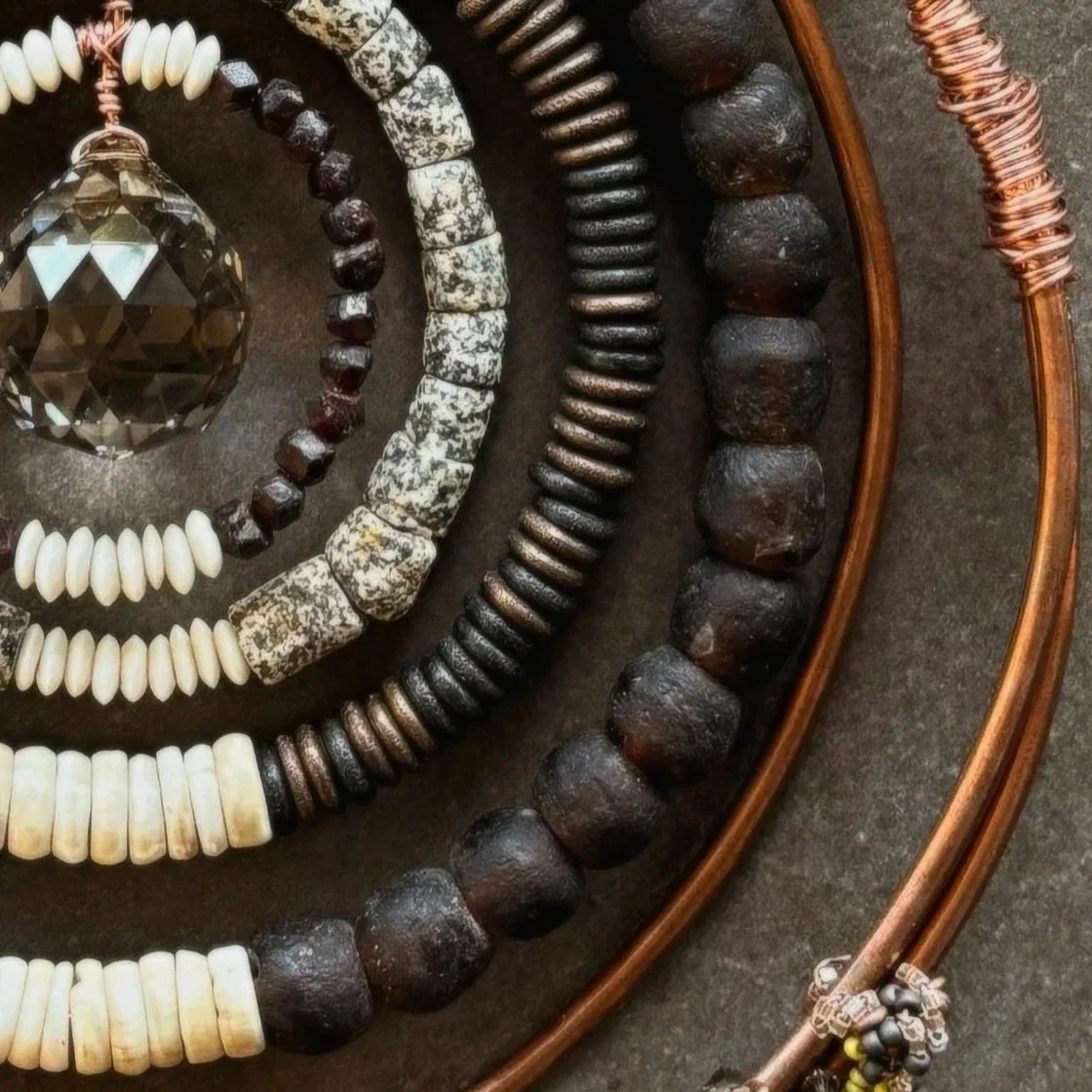
The Language of Beads
I have always been a collector. Of moss, old rocks, antiques, vintage and salvaged items. Drawn to things that carry memory. Things that have passed through hands and elements and continents and centuries and somehow arrived in mine. They whisper to me. Some of my greatest treasures, they are old stories of remembrance. To ancient times, to rock and tree, to our humanity. So, allow me to tell you their stories, hopefully they will live again with you.
African trade beads are perhaps the deepest expression of that pull. I use so many of them in my work — not as decoration, not as backdrop — but as the very language of what I make. Each bead is a sentence in a very old story.
These beads are artifacts of civilizations, of trade routes that stretched from the Mediterranean to the Sahara to the Atlantic coast, of people who assigned meaning and value and spiritual weight to small, handheld objects. They were currency. They were dowry. They were buried with the dead to ease passage into the next world.
If a bead could talk — what stories would it tell?
The Bead at the Center of the World
The history of African trade beads is not a single story. It is a thousand stories braided together across seventy-five thousand years — which is, remarkably, how far back bead-making on the African continent has been traced. The oldest man-made beads on earth were found in Blombos Cave in South Africa, fashioned from ostrich eggshell during the Middle Stone Age. These were not mere ornaments. From the very beginning, beads were signs — of belonging, of identity, of spiritual alignment with the world.
By the 4th century BC, glass beads were making their way into Africa from Egypt and the ancient Mediterranean world, arriving along trade routes that predated colonial contact by millennia. The Sahara was not a barrier — it was a highway. Camel caravans carried beads across the sands, and cities like Timbuktu and Djenné became legendary crossroads, places where gold, salt, slaves, ivory, and beads all flowed through. Chemical analysis of glass beads excavated in Mali has confirmed that their raw materials originated in Egypt, the Levantine coast, and the Middle East — the ancient world, arriving bead by bead in West Africa's heart.
Then came the Europeans. From the 14th century onward, Portuguese and Dutch and later Venetian traders began landing on West African shores, and with them came glass beads — vibrantly colored, intricately patterned, unlike anything glass-scarce Sub-Saharan Africa had ever seen. In a culture where beads were already a sophisticated language of wealth and spiritual power, these exotic foreign objects arrived like an entirely new vocabulary. African communities rapidly absorbed them into their existing bead traditions, elevating the finest examples to the status of royal currency, reserved exclusively for kings and their courts.
This is the golden trade era: roughly 1700 to 1920. Venetian glassmakers on the island of Murano became the epicenter of global bead production, churning out Millefiori, Chevron, and lampwork beads by the ton, destined for West African markets. Dutch and German workshops contributed their own varieties. Beads were used as ballast in ships on the outbound journey, then exchanged for ivory, gold, and — in one of history's darkest chapters — enslaved people. The beads that I hold in my hands carry this weight. I do not look away from it. It is part of what they are.
Today, those same beads have outlasted the empires that made them and the trade systems that carried them. They surface from Saharan sands, emerge from old strands in Mali marketplaces, pass through the hands of collectors and dealers and artists. They are not relics locked behind museum glass. They are alive, circulating still — and I am honored to be part of that circulation.
The Rare Ones: My Collection
These are the beads I reach for first. The ones that collections are built around. The ones that ask something of me when I work with them.
Old Annular Dogon Beads — The Donuts of Mali
ORIGINS & HISTORY
The Dogon people of Mali’s Bandiagara Escarpment — a region so isolated and extraordinary that UNESCO placed it on the World Heritage List — gave these beads their name, though they did not make them. These small, donut-shaped glass beads, called Ashara by the Dogon themselves, were produced in Holland and Germany between roughly the 1600s and the 1800s, wound by hand around a mandrel and shaped into their distinctive annular form. Archaeological evidence from a dig in Amsterdam in 2006 uncovered a large glass bead factory called “Der Twee Rozen” in the city’s Rozengracht district, active for over twenty years beginning in 1657 — almost certainly one of the primary production sites for these very beads.
The Dogon tribe, who made up over seventy percent of the Mopti region’s population, accepted these trade beads with particular enthusiasm — exchanging them for furs, goods, and, in that period’s grim economy, people. Crucially, the Ashara were not worn by everyone: they were reserved exclusively for chiefs and dignitaries, strung in necklaces alongside cast bronze bells as unmistakable marks of rank and authority. This was not everyday adornment. This was regalia. The beads were elevated further still by the Dogon’s own hands — artisans modified them by wearing down the sides so they would sit more uniformly on lengths of sisal, a detail that makes old annulars physically distinct from modern reproductions.
RARITY & WHAT MAKES THEM SPECIAL
Old annular Dogons are found most commonly in cobalt blue and translucent white, but the rarest come in amber, purple, and soft rose tones — these are genuinely difficult to source and command serious attention from collectors. The age shows: slight pitting on the surface, traces of the winding process where glass threads began or ended, imperfections that are not flaws but proof. Early examples sometimes feature a raised ridge around the perforation hole — the inevitable mark of the winding technique. These are distinguished from modern powder glass donuts from Ghana, which have a smoother uniformity. The old ones are rougher, warmer, more alive.
SPIRITUAL & SYMBOLIC MEANING
The Dogon people are among the most cosmologically sophisticated cultures in the world, and this is not incidental to these beads — it is the world they inhabited. The Dogon’s spiritual system centers on Amma, a supreme creator god, and on the Nommo — ancestral water spirits who in Dogon mythology descended from the sky to establish order, language, and sacred knowledge. Spiritual leaders called Hogon serve as the custodians of this cosmological inheritance, guiding communities in both worldly and metaphysical matters.
What makes the Dogon’s relationship to the cosmos especially remarkable — and genuinely contested among scholars — is their apparent astronomical knowledge. French anthropologists Marcel Griaule and Germaine Dieterlen, who spent decades living among the Dogon in the 1930s–50s, reported that Hogon priests described Sirius as a binary system with a companion star invisible to the naked eye — details only confirmed by Western science in the 20th century. Their cosmological tradition holds the Sigui festival every sixty years, tied to the cycle of this star. Some researchers argue the knowledge is ancient and inexplicable; others suggest it may have entered Dogon tradition through early contact with European astronomers. What is not in dispute is the extraordinary depth of the Dogon worldview — a fusion of astronomy, mythology, architecture, and ritual. The chiefs who wore these beads strung with bronze bells were not simply wearing jewelry. They were wearing the universe.
Roman Road Glass — Two Thousand Years in the Earth
ORIGINS & HISTORY
Roman glass beads are among the most humbling objects I have ever held. The material itself — the actual glass — dates to the first and second centuries AD, the height of Roman imperial production. Roman glassmakers, who learned their craft from the conquered Egyptians, perfected the art of glassblowing in the 1st century AD, revolutionizing production and flooding the ancient world with glass vessels: vases, goblets, perfume bottles, window panes. These objects traveled the Silk Road from Rome to Central Asia, to the Middle East, to distant corners of an empire that stretched across three continents. Many were eventually buried, or simply lost — and they lay in the earth for nearly two millennia.
The beads we call Roman road glass today are made from fragments of those ancient objects, primarily excavated in Northern Afghanistan — in Balkh province, along what was once the Silk Road. Artisans drill and thread the recovered shards, creating beads from material that was already old when the Roman Empire fell. Each bead is a fragment of something else: a perfume bottle, a wine goblet, a window from a Roman villa.
RARITY & WHAT MAKES THEM SPECIAL
What makes Roman glass visually extraordinary is the patina. Centuries of burial cause the glass to undergo a chemical process called devitrification, as mineral deposits slowly bind to the surface and layer upon layer of iridescence builds up — soft rainbow sheens of blue, green, silver, and gold that no modern glassmaker can reproduce. This lunar iridescence is what collectors are really seeking, and beads with heavy, well-developed patina are significantly rarer and more valuable than those with only faint mineral deposits. No two pieces are alike. Each strand tells its own geological story.
SHOP: Roman road glass beads
Old Mali Stone Beads — Djenné and Timbuktu
ORIGINS & HISTORY
Mali’s ancient cities — Djenné and Timbuktu — were among the most important centers of learning and trade in the medieval world. For centuries they sat at the crossroads of trans-Saharan commerce, where caravans from North Africa exchanged Mediterranean goods for West African gold and salt. Stone beads — worked from granite, quartz, and other local materials — were a cornerstone of that exchange. Granite beads excavated in the Djenné region have been dated to roughly a thousand years old, shaped individually and graduated into strands that served as both adornment and portable wealth.
Archaeological research published in PLOS ONE has confirmed that glass beads found at sites in central Mali between the 7th and 13th centuries AD had their raw materials traced to Egypt and the Levantine coast — evidence that even the remotest corners of West Africa were woven into global trade networks a thousand years ago. But the stone beads are a different matter: these are local, indigenous, made from what the land provided. They are the beads that were here before the Venetians arrived.
SPIRITUAL & SYMBOLIC MEANING
The people of Mali’s great empire were profoundly and complexly spiritual — and that spirituality was never simple or singular. At the height of the Mali Empire, animist traditions that had been practiced for millennia existed side by side with Islam, and even the empire’s most devout Muslim rulers never fully abandoned their ancestral beliefs. The mansa (king) served not only as political leader but as spiritual guardian — the person with the most direct connection to the spirits of the land and the ancestors who had cultivated that relationship across generations. Beads in this context were never mere decoration. They were worn at the intersection of the earthly and the sacred.
Timbuktu’s great universities — including the famous Sankore mosque and its attached madrasas — were centers of study that extended far beyond religion. Scholars there studied history, geography, medicine, mathematics, and astronomy, building libraries of tens of thousands of manuscripts, many of which survive to this day. The hajj pilgrimages undertaken by Mali’s rulers opened the empire to the knowledge of the wider Islamic world and brought that knowledge home. The result was a civilization that understood the stars, venerated its ancestors, and placed spiritual meaning at the center of daily life. The stone beads that circulated through this world carried all of it.
RARITY & WHAT MAKES THEM SPECIAL
Genuine old Mali stone beads vary enormously in material — granite, gneiss, quartz, various sedimentary stones in warm ochre, grey, and rust tones. Their age is evidenced by their surface: chipping on edges, the smooth mellowness of long-buried stone, drill holes that are slightly irregular and hand-made. Each bead was individually shaped and graduated in the stranding, resulting in organic, imperfect beauty that is the exact opposite of machine precision. These are beads that were made to last, and they have.
SHOP: Old Mali Stone Beads
Recycled Ghana Glass Beads (Krobo) — The Circle Made Whole
ORIGINS & HISTORY
Of all the beads in my collection, the recycled Ghana glass beads may be the ones that move me most in terms of philosophy. These are Krobo beads — made by the Krobo people of Ghana’s Eastern Region, in the Krobo Hills and surrounding communities — and their making is a meditation on transformation. The process begins with waste: broken bottles, discarded glass vessels, fragments of colored glass gathered and sorted by hue. This material is ground into a fine powder, packed into terra cotta clay molds, layered with different colored powders to create patterns, then fired in a kiln. What emerges is a bead formed entirely from what was thrown away — reborn, whole, luminous.
The Krobo people have been making beads since at least the 9th century AD, according to oral records — though early versions were made from stone, bone, and wood. When European traders arrived on the West African coast in the 16th century and introduced glass beads as trade currency, the Krobo absorbed the material into their own traditions, eventually developing the powder glass recycling technique that defines their beadwork today. Glass bead-making became so central to Krobo identity that it shaped the community’s entire economic and spiritual life. The communities of Odumase Krobo and Somanya in the Eastern Region became the epicenter of a bead economy still thriving today, with master artisans passing techniques down through families across generations.
The Krobo developed an extraordinary symbolic language within their beadwork. Specific patterns reference Adinkra symbols — the visual vocabulary of Ghanaian wisdom — while color carried precise cultural meaning: green for recovery from illness and new life, red for mourning, white for purity and victory after childbirth, yellow-orange for the sacred transitions of puberty. The Dipo ceremony — the Krobo coming-of-age ritual for young women — centered on beads entirely, with initiates adorned in specific sequences that communicated their readiness to cross into womanhood. Some ceremonial bead types were considered too sacred for commercial exchange. Beads accumulated over a lifetime served as an ancient pension pot, sellable in times of hardship. They were placed on newborns to ward off illness, used to monitor infant weight (when a waist strand slipped over a child’s hips, parents knew something was wrong), and sent with the dead for the journey ahead.
RARITY & WHAT MAKES THEM SPECIAL
What makes authentic Krobo powder glass beads recognizable is their surface. The traditional clay kiln firing leaves a slight pitting — a gentle roughness that no machine-made bead can replicate. The glass has heft and weight. The colors have depth, not flatness: the most skilled artisans layer up to twelve distinct color zones within a single bead no larger than a fingertip, with patterns that permeate the entire structure rather than sitting only on the surface. Some masters incorporate the Gyawu Atiko spiral — a symbol of continuous learning — or the Nyansapo wisdom knot into their designs. These are not decorations. They are texts written in glass.
SHOP: found throughout most my work